
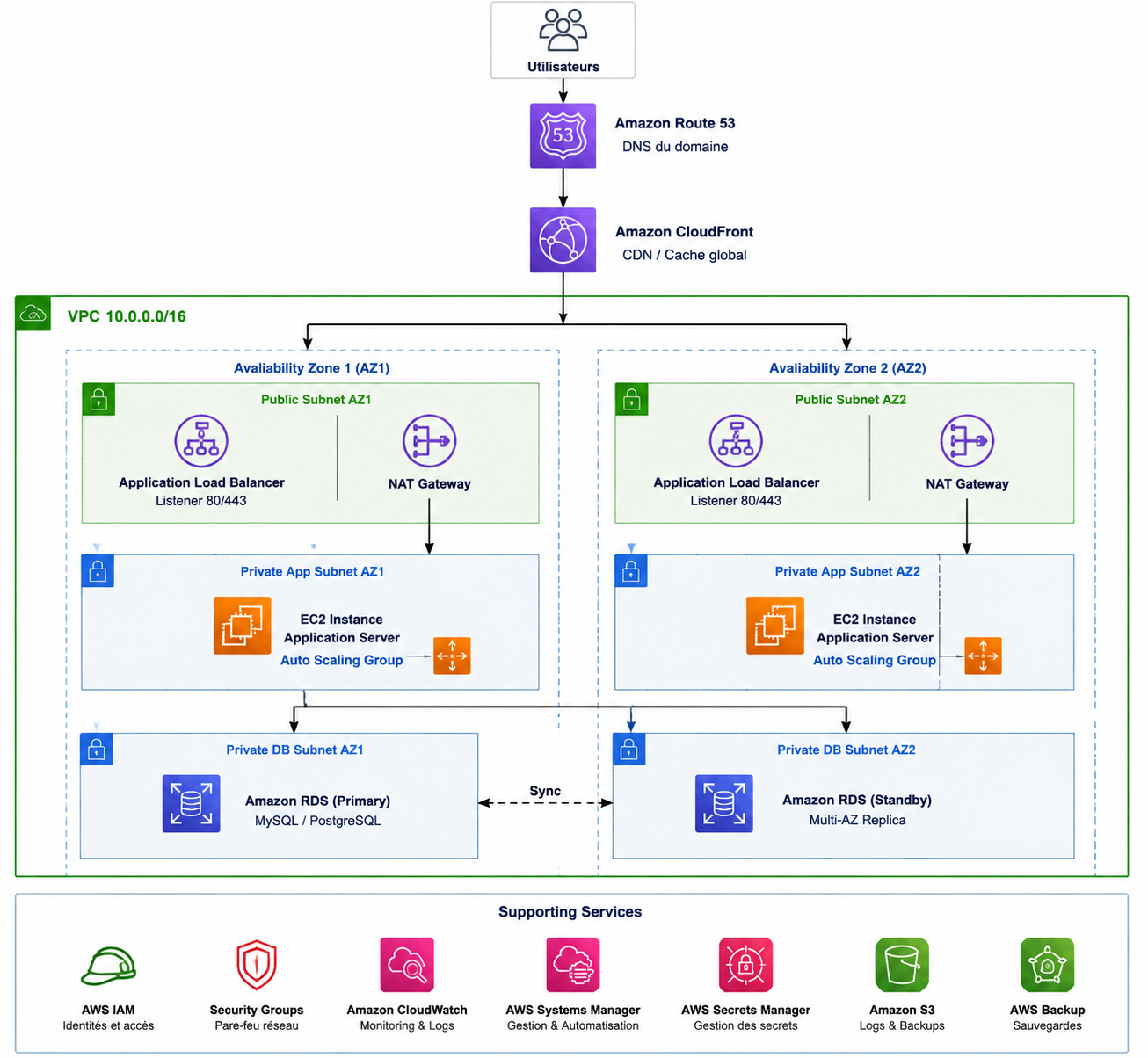
This architecture provides a practical foundation for deploying a cloud-native application on AWS with a strong balance of availability, security and performance. It relies on a clearly segmented VPC, a multi-AZ layout, an edge delivery layer and a database tier isolated in private subnets.
Start with a clean network design
The first priority is to organize the network in a readable way:
- public subnets for exposed entry points;
- private subnets for application services;
- data services that are not directly exposed to the internet;
- simple traffic controls that remain maintainable over time.
This separation reduces the exposure surface and makes the flow between components easier to understand.
Build for high availability
A multi-AZ deployment improves platform resilience. If one availability zone is affected, the application can continue serving traffic as long as critical components were designed with proper failover behavior.
In practice, that means focusing on:
- distributing application services across multiple AZs;
- avoiding single points of failure;
- monitoring failover mechanisms;
- testing recovery scenarios regularly.
Use the CDN and entry layers effectively
Placing a CDN at the front of the platform brings immediate benefits:
- faster content delivery;
- better absorption of traffic spikes;
- lower latency for end users;
- an additional protective layer in front of downstream services.
The CDN does not replace sound application design, but it meaningfully strengthens platform stability when combined with well-defined entry points and cache policies.
Protect the database layer
The database should remain in a tightly controlled zone. In a healthy architecture, it is never treated like an internet-facing component.
That usually means:
- restricting access to authorized services only;
- centralizing secret management;
- validating backup and restore procedures;
- paying close attention to replication and recovery design.
Conclusion
Strong AWS architecture is not about stacking services together. It is about making trust zones, traffic flows, control points and resilience mechanisms explicit. This first article creates a foundation for future deep dives into VPC design, multi-AZ availability, access security and deployment industrialization.
Discussion
Comments
Readers can react, ask a question or continue the conversation. A GitHub sign-in is required before posting a comment.
The GitHub comment module is not configured yet. Add the Giscus environment variables to enable discussions on this page.